


EXHIBITION
EXHIBITION:
The French and the Creation of the United State
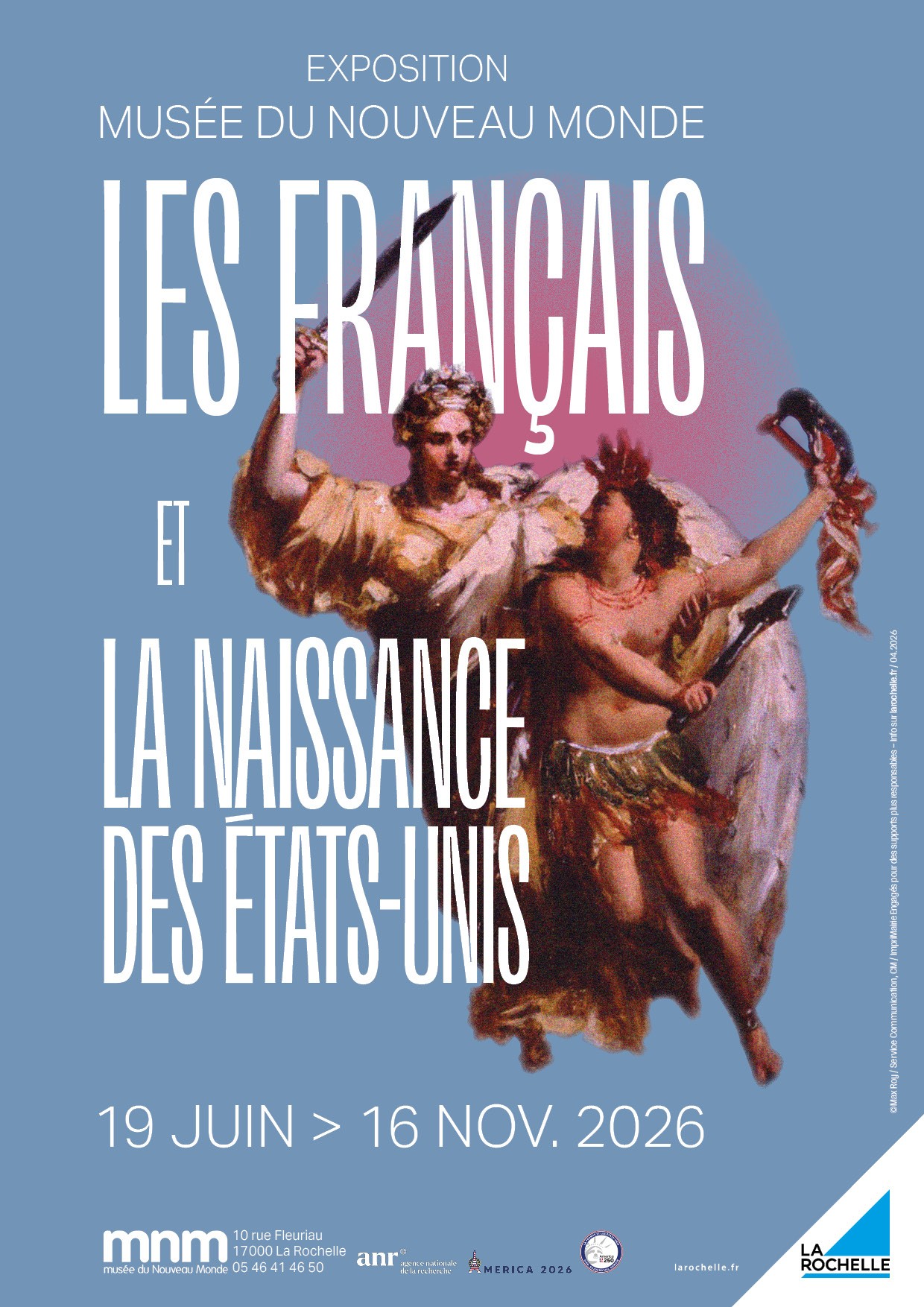
From June 19 to November 16, 2026, the Musée du Nouveau Monde (Museum of the New World) at La Rochelle is hosting an exhibition illustrating how French people knew about the American Revolution and how they reacted to the creation of a new political system across the Atlantic. A variety of over 50 prints, paintings, objects, books, old maps and manuscripts reveals the multifaceted echo of American Independence in France in the late 18th and early 19th centuries.
This exhibition thus presents to the school and the general public a decentered view of American events, in order to allow them to further see the connections between America, Europe and the world in the second half of the 18th century. It is funded by the ANR AMERICA 2026 program and the city of La Rochelle.

The Musée du Nouveau Monde (Museum of the New World) is located in an eighteenth-century town house, the former residence of Aimé-Benjamin Fleuriau, a prominent sugar planter and merchant. When it was created in 1982, the museum was one of the first institutions to address slavery through items connected to the slave trade and depicting life in a West Indian plantation. Ousmane Sow’s statue of Toussaint Louverture stands in the middle of the courtyard as a reminder of La Rochelle’s slaver past.

The Musée du Nouveau Monde is dedicated to the connections between France, with a focus on the port of La Rochelle, and the Americas since the 16th century. It illustrates how the Europeans explored and appropriated the land they called the “New World”. The museum collections include paintings, prints, sculptures, maps and artefacts showing European perceptions of Brazil, Canada, Louisiana, and the rest of the continent. It also features 18th century French and American furniture.
The exhibition includes centerpieces such as :

The sketch of Louis Charles Auguste Couder’s painting commemorating the common victory and the friendship between France and the United States during the Siege of Yorktown in October 1781. It Other paintings, prints and statuettes glorifying the Franco-American alliance are presented as well.

A 19th century gilded bronze and silver clock, known as the “Indian clock”, is also part of the museum collection. It was made in France by Denière & Cailleaux circa 1835. The United States is personified by a victorious female Native American standing over a stela where an inscription reads “United States, Colombia, Mexico, Peru”. The American Revolution thus appears as the first in a chain of successful revolutions on the American continent that resulted in the creation of new independent states.

A terracotta medallion designed by Jean-Baptiste Nini in 1777 is one of the many portraits of Benjamin Franklin that were on the French market during the US envoy’s stay in France (1776-1785). It exemplifies how Franklin managed the public image of the unsophisticated American scientist-philosopher that made him so popular.
These are a few examples of the many items showing that the French reception of the American Revolution had a much larger scope than the military alliance and triggered the production of a specific iconography and of a number of artefacts in the context of the beginnings of a consumer society and of Atlantic revolutions.


Exhibition committee
-
The exhibition committee is composed of Florence Petroff (La Rochelle University), who serves as the exhibition’s scientific curator; Mélanie Moreau (Museum Director) and Aline Carpentier-Le Corre (Head of Collections), who serve as its general curators; as well as Carine Lounissi (Rouen Normandie University), Françoise Coste (Université Toulouse – Jean Jaurès), Ghislain Potriquet (University of Strasbourg), and Leïla Tnaïnchi (Université Paris 8).
